Digital Lab Assignment #7: Twitter Bots ~OR~ Are Xanax and Pizza Relatable?

More Twitter Literature (Twitterature! Can I get a patent on that?) coming your way.
Ah, bad news folks. I looked it up, and apparently “Twitterature” is already a thing. #borninthewrongera

Anyway, so, this week I made a Twitter bot (that’s not illegal right?)! Here is the link to the bot’s account if you’re interested. It was actually pretty fun! Essentially, you create word banks full of words or phrases, and then give the bot options (called ‘origins’) on how to organize those words and phrases. It is written in JSON code, here is a copy of the code I used (it’s a bit long, you definitely don’t have to read the whole thing, but this will give you an idea of how the Twitter bot works).

{
“origin”: [
“#pronoun# #verb# #reason#, and #then# #outcome#”,
“#action# in #place# #seems# #adjective#”
],
“pronoun”: [
“I”,
“My dogs”,
“The voices in my head”,
“My parents”,
“The father, the son, and the holy ghost”
],
“verb”: [
“died because of”,
“found”,
“took all the drugs and thought they were”,
“fervently worship”
],
“reason”: [
“John Cena”,
“penguins”,
“a clock”,
“the internet”,
“the browser ‘firefox'”,
“pizza”
],
“then”: [
“that’s why”,
“then I discovered”,
“now I feel like”
],
“outcome”: [
“I can’t be sincere.”,
“I was asleep.”,
“I was late for work.”,
“the world is going to end.”,
“depression is a thing.”
],
“action”: [
“Crying”,
“Taking Xanax”,
“Filming an X-rated movie”,
“Making out”,
“Ordering pizza”,
“Being stoned”,
“Eating alone”,
“Dying”
],
“place”: [
“the White House”,
“public”,
“space”,
“a factory that processes peanuts”,
“a bar”,
“7-11”,
“my kitchen”,
“my cubicle”
],
“seems”: [
“seems”,
“sounds”,
“is”,
“was”,
“might be”
],
“adjective”: [
“fun.”,
“impossible.”,
“a little sad.”,
“actually kind of enlightening.”,
“addicting.”,
“arousing.”
]
}

Using this code, I set the tweets to post randomly every half hour so I could get some examples, such as:


In writing the codes for my Twitter bot, I chose sentence structures that were common in Mira Gonzalez and Tao Lin’s Selected Tweets (which we have been studying). For example, “[pronoun] [did something], and [that’s why something else].” seemed to be a frequent structure. As well as “[doing something] in [a place] [was/is] [adjective].” So, my two origins were based on these structures.
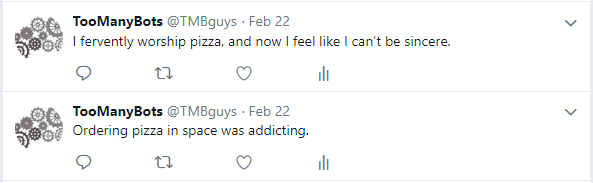
Examples of each structure. The bot randomly chooses from each of the origins (structures).

I also used words and phrases to fill my word banks that were frequent in Gonzalez and Lin’s tweets. I chose to do this because the nature of the two poets tweets are very random, and have ridiculous premises. Obviously, people tweet things like that though, so a bot that spouts out similar tweets wouldn’t be absolutely ridiculous (well, I suppose that’s debatable).

In doing this project, I wasn’t necessarily trying to create a bot that would create literary valuable tweets, but I was trying to create one that was more relatable than your average bot. Also, I aimed to create tweets that played off of the random nature of a twitter bot. I think I succeeded in this goal, most of the tweets made sense, and could have been posted by a real person. Also, I think they were some pretty entertaining tweets!

House knows what’s up.

Comparing this form of literature with the previous twitter literature I created, I would definitely say that creating a “twitter story” is more literary valuable. Creating a Twitter story gives you so much more freedom and variables you can play with. Using a twitter bot, you would not really be able to create a coherent story across multiple tweets, because it is just so random. You could definitely use a Twitter bot to create multiple short stories in singular tweets. The more words you have in your word banks, the more stories it would create, but each story would be limited to a separate tweet. So, I believe that you can definitely create more valuable literature on Twitter without a bot.

That being said, I do not think that bots take away the humanity of writing tweets. You are still required to write all the code, phrases, word banks, and structures yourself. There is still quite a bit of creativeness and detail that has to go into creating the code for these bots. It is certainly a form of literature, although it has more limitations than “traditional” literature. I would also argue that this form of literature doesn’t “mass produce” content, At least, not any more than content is already mass produced on Twitter.

Creating a twitter bot was a very interesting experience, and I think it would be a lot of fun to keep expanding on my structures and word banks. Although, before I do that, I would really like to create some more twitter stories! I think there are so many fun options, using multiple accounts, and/or retweets, and/or other aspects that twitter can offer.

Thank you for reading! I hope you enjoyed!

Digital Lab Assignment #6: Twitter Stories! ~OR~ I’ve Read it Both Ways

Ah, Twitter. The ultimate collection of hysterical celebrities, illiterate masses, and random clutter posts that have no apparent meaning or value. Of course, Twitter does have contributions to offer to the world; quick news flashes, a good platform for bouncing ideas off of like minded people, and some would even say a good source of memes.

Good ol’ Twitter.

However, most people, from what I have observed, do not expect anything of specific literary value to come from Twitter. This isn’t necessarily surprising, I mean, each tweet can only be 280 characters long. However, some people, like Tao Lin, believe that tweets have an inherent literary nature.

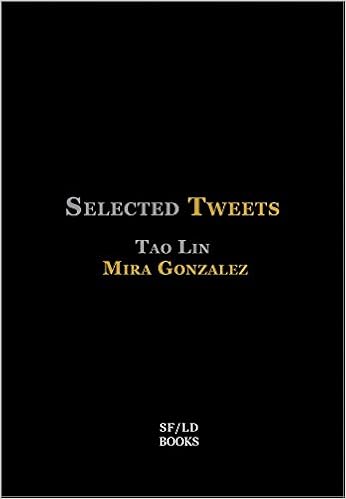
Selected Tweets; a faux leather, embossed novel filled with tweets from these two poets.

Tao Lin and Mira Gonzalez picked some of their tweets to publish in physical book form. But they didn’t stop there, they decided the cover should be faux leather, and that it should be silver and gold embossed. This book is very entertaining, but the important part is that it raises the question of the literary potential of Twitter. Despite Twitter’s limitations and quirks, can I also create something of literary value? I attempted to and, if I do say so myself, I believe I succeeded.

@ME after I finished my Twitter story. Except #noskimmilk

So, the point of this post is to talk about my story. You can read it on Twitter here. Or here. Or click here if you want. All the links lead to the same place. I just really think you should read it.

There were a couple options for writing my Twitter story, either writing one story that took place over multiple tweets, or writing multiple short stories that each had their own tweet. I chose to write a story that took place over multiple tweets, and then add another twist on top of that. I realized that if I wanted to make my story coherent, I would have to post each tweet backwards, so that when you are scrolling from the top down, it reads like a normal story. Then, I thought, “What if I wrote my story so that it could be read either way the user scrolled?” So, I attempted to write a story that was broken up into little segments, and could be read forwards and backwards.

Personally, I think my attempt was successful! I really like this piece of literature because I have never written, or seen, a story that can be read backwards and forwards (I wouldn’t be surprised if one already exists, but I haven’t read any). Interestingly enough, the restrictions and specifications of the Twitter platform, in my opinion, enhanced my story. Each tweet has its own separate box, so I didn’t have to worry about my readers accidentally combining portions of the story in their head, or skipping over parts while scrolling back up. The scrolling aspect of Twitter also helps my story, because scrolling back up the posts in a profile is much easier than flipping through a book backwards. I also appreciated the fact that each section of the story had to be 280 characters or less, it created a fun challenge for me!

If one were to accept the “Twitter story” as a genre, I believe that this genre does have literary value. Because of the unique platform Twitter has, it opens up new veins for creative aspects in stories, as you can see through my story. There are so many more options to be explored through this medium with writing stories. Using retweets and comments and such, you could essentially create a living dialogue in your story, for example. There are so many possibilities! I think the Twitter story is also valuable because people are spending increasing portions of their days on social media. In order for authors to continue spreading their works and ideas, they can post stories, or teasers to their stories, on twitter to try and reach a large audience. There is definitely a large market on Twitter, and it would be foolish to not take advantage of that.

I hope you enjoyed my story, and this blog post! Thank you for reading!

Digital Lab #5: Tell Us in Your Own Words ~OR~ Here I Go Again

Once again into the fray with emoji’s (See Lost in Translation)! This time, I created my own story in emojis, and it was much harder than I expected it to be!

For some reason, I thought we were supposed to make a poem of some sort, and I had a song stuck in my head, so I attempted to base my story off of a song or two (comment below if you can tell which songs!). Based on my knowledge of the songs, I attempted to create a story that tied the two together. Because of the small amount of emojis I had, and the difficulty of writing with them, I think that this project was more limiting than simply translating a chapter from Xu Bing’s Book From the Ground. The most frustrating thing, though, was that all the emojis changed (and some didn’t show up at all!) after I shared it with my project partner on Google Docs. It looked just how I wanted it to before I shared it, and then everything changed when the fire nation attacked.

Fortunately, my partner was awesome and was still able to make sense of my story and translate it!

Somehow, he translated my terrible emoji storytelling skills into a story that was pretty accurate to what I was getting at. He did think that my character traveled to France, when the flag I used was actually a Russian flag (that is what the “RU” means on the document above). But the fact that my character traveled came across still, which is the important part. The translation was also skewed because I was not able to differentiate between different characters of the same gender very easily in emojis. For this reason, he thought that I meant to say “I don’t feel lucky to be in France” but what I meant to say was “[Another person] doesn’t know how lucky he is to be in Russia.” I bring this up because I used the same set of emojis to say this multiple times.

France’s flag (left) and Russia’s flag (right). ‘A’ for color scheme, ‘F’ for originality.

My partner did also understand my transition segment. While in Russia (or France), my character went to the beach with a woman, but it began to storm. He got that right. Then he inferred that my character instead took his date to a restaurant called the “Octopus House.” Which is a cool name if you ask me. However, what I had intended was for my characters to dive into the ocean and then find a literal octopus’s house where they hung out.

(Sidenote: Does anyone know if octopuses live in homes? Or do they just roam around? I think it would be cute if they had little nests or something.)

The story still has a happy ending though! My partner translated that when the storm was over, my character and his date fell in love. Which is what I intended to happen in my story. Yay! Go character!

Reading the translation of the story, I really appreciated my partner’s creative liberties with expounding upon certain aspects of the story. I also really enjoyed his word choices in his translation, they made the story feel relatable and authentic, in my opinion.

Overall, my interpretation of “Literature by the Numbers” has not changed much since my last post. But it was still fun to play around with emojis, and it was interesting to see how my partner translated my story!

Thanks for reading!

Digital Lab Assignment #4: Lost in Translation ~or~ 📖😀😊😶🤔&🚫🔠〰🎥🎬❓

👋❗ 🙏🔎💻❗

👁〰📖📅. 📖〰🌄➡📘. ✍〰😃😛😮🙁😬😉❗ 🚫🔠 ❗

😁👍✔. 👤😵❓ 👌.

Imagine reading a whole book that is only written like that! Some people shudder at the idea of struggling through a novel with only emojis, but others are intrigued at the idea. The book I am referring to is Xu Bing’s Book From the Ground: From Point to Point. Bing is a visual (and sometimes linguistic) artist that wrote about the life of an average office worker, using only emojis. Bing wanted to create a novel that anyone could read, regardless of what language they spoke. He created it partially as an antithesis to his work Book From the Sky, which is equally as fascinating, but nearly impossible for most people to read.

Picture of an installation of Xu Bing’s Book From the Sky at the Blanton Museum of Art

In our Literature by the Numbers class, we discussed the implications of using this as a language. Does it count as a language? Does it replace language? If so, is that a bad thing? Or a natural evolution of language? These are definitely interesting topics of discussion, but not what this post is about. In order to examine the relationship Book From the Ground has with language, each person in our class translated a chapter from the book into a form of their choosing. I was assigned to the first chapter, and I decided to turn it into a script for a screenplay.

Excerpt from the first chapter of Xu Bing’s Book From the Ground.

I’m sure that I made lot’s of technical errors in the actual forms and whatnot of screenplays, but it was definitely fun to try!

We also got paired up with a partner who translated the same chapter, but in a different way. This led to some interesting discoveries about the differences between interpretations of the same chapter, and the successes and shortcomings of emojis as a language.

As you can see, my translation is much different than my partners translation, but it got across the same story. While I was writing my translation, the ambiguous nature of the language actually helped me to write my screenplay. There was a lot of freedom about the specifics of the story, so I took some creative liberties while writing the screenplay. The way I translated was also more in depth than other options, and it took more time than I thought it would. In the end though, it made me appreciate the possibilities that the vagueness of the emoji medium offered.

Comparing my translation to my partners, I thought it was interesting that we interpreted certain details into our translation that were not included in the book. For example, we both said that the main character’s cat walked on his face to wake him up, but that was not specified in Xu Bing’s book.

(I know this cat isn’t on the person’s face, but it’s really cute)

My partner and I also both gave the main character and his cat specific characterizations. We gave them names, thoughts, and identities that were not included in the book. Similarly, we both were very in-depth with our translations. We had the option to just say “A bird was singing outside. A guy woke up and turned off his alarm clock. His cat came and woke him up…..”, but neither of us did. We were both compelled to tell a story, one that had intricacies and interesting details. I’m not sure if that says more about us, or more about the book we were translating, but it does show the need for humans to make explanations for what their brains are thinking.

Now, talking about these translations in the context of “literature by the numbers”… Although it is difficult to think of language in the term of numbers, emojis bring the relationship between language and numbers closer. Emojis are inherently digital, and although they are conveyed through an image, they are, at their core, a collection of ones and zeros. If we do accept emojis as a language, then they can be analyzed digitally more than most languages can. This shows that language itself can be quantified under the right circumstances.

This brings up the question; “So what?” Why would you want to quantify language? Well, my answer is that I, personally, don’t. Not right now. But later I might want to quantify a certain aspect of people’s communications with one another for an experiment, for example. For that reason, maybe I will try to use a language that has a closer relationship with numbers than English does. Like emojis, or some other form of language that happens to pop up. The possibilities, really, are endless.

If you are interested in the possibility of emojis being a language, or just intrigued about reading a book written entirely from emojis, check out Book From the Ground! It is a very entertaining read!

I hope you enjoyed this post! 🙏 👁〰💻❗

Digital Lab Assignment #3: Dismantling Frustrating Texts ~OR~ Mary Do You Wanna…

The inspiration for this week’s assignment came from Jordan Abel’s long poem Injun. I would definitely recommend at least listening to the reading that is in the link I provided. It is an amazing project. Abel created his poem by cutting up words from a source text of pieces of text that offended him (by using the derogatory word Injun). He arranged and rearranged the cut out words and ended up with this as one of his segments:

Excerpt from Injun by Jordan Abel.

We were asked to bring a piece of text that offended us, or at least one you wanted to deconstruct. I do not get offended easily, even for a straight white male, so I settled on something that I wanted to shred apart. During the whole fight around Proposition 2 (referred to the church by “the Marijuana Initiative”, this was the proposition that wanted to legalize medical cannabis use in Utah), the LDS Church sent out a statement of why they opposed Proposition 2. During their whole crusade, most of their information was either misleading, or not based on any real facts. The excerpt I dismantled was no exception.

I began dismantling my piece using an online tool called Voyant. I copy/pasted about a page from the LDS Church’s list, and Voyant gave me data on each word and its structure in each sentence.

Screenshot of the data analysis that Voyant gave me.

Immediately noticeable is the fact that ‘cannabis’, ‘marijuana’, and ‘medical’ are the three most used words in my piece of text. Obviously, the text is about medical cannabis, so it’s not surprising that those are the top three hits. However, upon closer inspection, I realized that the word ‘medical’ only appeared before the word ‘marijuana’ or ‘cannabis’. This use of ‘medical’ is only a pre-implemented explanation of the word ‘cannabis’ or ‘marijuana’. This makes it seem like the LDS Church isn’t concerned with any of the medical issues that are the reasons medical marijuana is needed in the first place. Additionally, they claim that their interest is in keeping people safe, but the words ‘person’, ‘people’, or any other compassionate term, do not show up even in the Top 10 most frequent words. The word ‘Utahan’ only appears once, and ‘safe’ or ‘safety’ or any other term with that meaning? Not at all.

Lawn signs in support of Proposition 2.

So if they aren’t concerned with that, what is their issue with Proposition 2? One recurring theme that seems to be an issue is the medical cannabis dispensaries. The LDS Church finds multiple reasons why the medical marijuana dispensaries, and the regulations surrounding them, will be inefficient or will “hamper the law” (again, their claim for this point is based on no factual evidence).

Now, add in to the mix the fact that the LDS Church has purchased major stock in pharmaceutical companies. I could go on a whole tirade about this, and the abuse-of-prescription-drugs-epidemic in Utah, but basically a very major source of the church’s (unethically sourced) funding comes from pharmacies. The medical marijuana dispensaries, however, would be independent from any pharmacies or corporate drug producers. If medical marijuana were to be dispensed as proposed, it would immediately alleviate anybody’s need for many prescriptions drugs and their terrible side effects (not to mention their lack of effectiveness). This would cause a large drain on the income for pharmacies, and thus would be a huge cut in the church’s paycheck. It seems like the LDS Church is against the dispensing of medical cannabis for the simple reason that pharmacies (or themselves) are not involved in it, and therefore will not get any cut of the benefits.

A comic that I think perfectly represents the need for medical cannabis, and why the LDS Church has been fighting so hard against it.

Keeping all this in mind, I ended up creating this project out of the text I chose:

Picture of my finished project.

I began by cutting out key words I believed were important to the issue and laying them on the ground. I actually originally arranged them in sentences, which helped me express my thoughts. However, after some experimentation (and frustration after my cat walked over the pieces and scattered everything about), I came upon the above format, which I must say I am very proud of.

I hesitate to explain everything in my piece of work above, because I feel that it takes the fun out of everything. However, after explaining my interpretation of the data given to me by Voyant, and given my cynical view of the LDS Church’s motives, I’m sure this piece can be entertaining to you as well.

Thanks for reading!

Digital Lab Assignment #2: (QR) Code in Literature ~or~ Anthropomorphism is Fun (to Write)

Inspired by the project Between Page and Screen, by Amaranth Borsuk and Brad Bouse, a partner and I created a conversation between alternate versions of page and screen. Here is the epistle that I created (this should be read first):

Screen: http://www.betweenpageandscreen.com/epistles/1uvIv5zL

And here is my partner’s response:

Page: https://www.betweenpageandscreen.com/epistles/LcdASYPg

In order to read these pieces of literature, you will need to use this QR code and your computer’s camera. You can either take a picture of it and hold your phone up to your camera, or you can print the QR code out.

Now that you have read those (or not. I guess you don’t have to read them. But it may help you to understand what I am talking about if you do.), let’s discuss this form of literature.

From Between Page and Screen

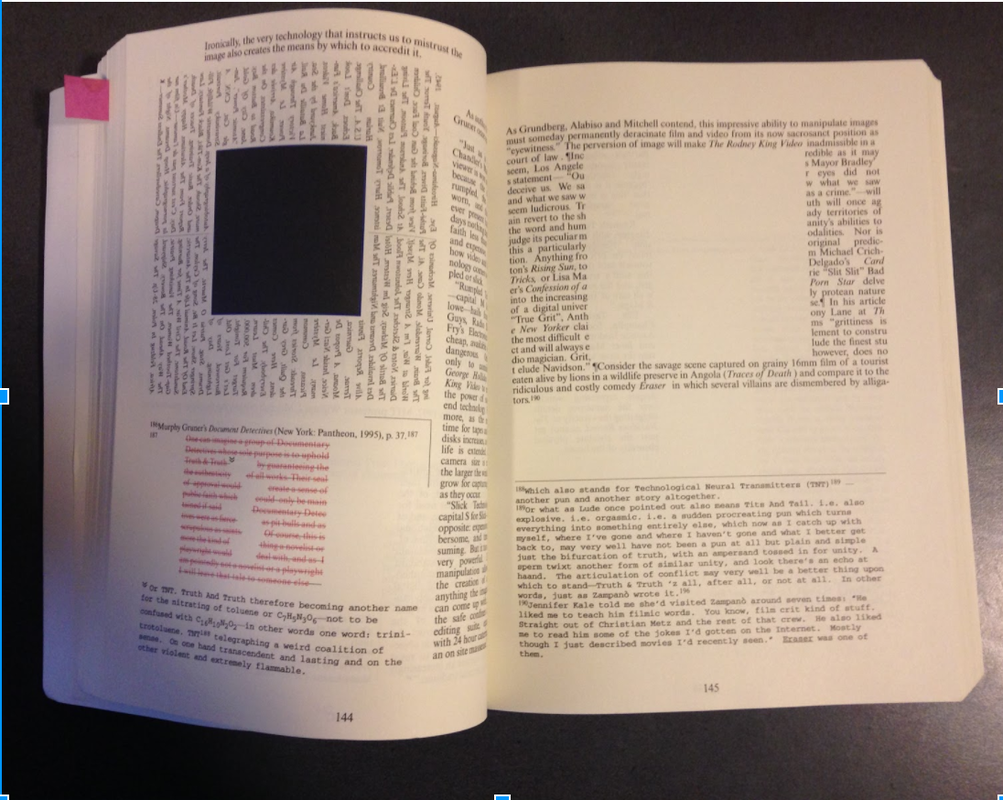
Firstly, there is the matter of the QR code as the medium to epitomize the relationship between page and screen. The QR code is just one of many ways something not digital can communicate with something that is digital, so I feel it was an effective way to illustrate the relationship between page and screen. You are required to use both paper (if you actually buy/print out the book) and screen to read about these two mediums. Additionally, I would say that this is a form of ergodic (meaning difficult to traverse or read) literature, which I feel is a fantastic elaboration on the complicated and tenuous relationship between the two parties in question. However, I do feel that there is much more to be said about the relationship between page and screen than the QR code can convey. That being said, I would be hard pressed to come up with another code to use to illustrate the relationship between page and screen. The QR code is definitely an effective way to communicate the interaction, but it is not the epitome of their relationship.

Another example of ergodic literature.
From House of Leaves, by Mark Z. Danielewski

One large theme of the relationship between page and screen is whether or not one is more prevalent than the other. I do think that screen is becoming more prevalent than page, but not through any fault of his own, he is simply the medium in the literary machine of cybertext. In my opinion, both mediums and forms of literature are equally as valuable and important, but I see Page as being more at risk. The screen as a medium is becoming more and more prevalent, and definitely seems to be overtaking the medium of page. However, if I were to anthropomorphize these mediums, I do not think that it is screen’s fault that he is taking over page. He is at the mercy of humans; they will use him as they see fit and there isn’t much he can do about it. Thus, we can see the screen as being a part of the machine of cybertext, because users are an integral part of it’s literature, even more important than the screen itself.

Image result for anyway gif

Alright….went off the handle a bit there. Regardless, it would be interesting to examine the relationship between page and screen through a format that conveyed screen’s interactivity with cybertext. But, again, I am hard pressed to say what that would be. Let me know if you think of a way that could work! For now, Between Page and Screen is a fantastic illustration of the tension and relationship of these two prominent mediums in the literary world. If this post intrigued you, definitely check out Borsuk and Bouse’s work!

Thanks for reading!

About Me (for real) ~or~ Welcome to the Machine

My name is Micah Taylor, I am currently an undergrad student at the University of Utah. I have created this blog space/website primarily for the class “Literature by the Numbers” taught by Dr. Aislinn McDougall. So most of my posts will probably be about literature. Or numbers. Or both. Maybe neither, who knows? Definitely not me. Anyway, I was born in Utah, moved away for a bit to live in Washington, and now I’m back and was raised (mostly) in Utah. I love Utah because of all the amazing outdoor activities/opportunities. I also love to read, play games of any type, and act. Music is another passion of mine, whether I am playing it or listening to it. I am always interested in learning new things, about anything and everything. I like to have intellectual conversations, but I also like to be funny, so hopefully this website will reflect both of those aspects. Thanks for visiting, I hope you enjoy!