
More Twitter Literature (Twitterature! Can I get a patent on that?) coming your way.
Ah, bad news folks. I looked it up, and apparently “Twitterature” is already a thing. #borninthewrongera
Anyway, so, this week I made a Twitter bot (that’s not illegal right?)! Here is the link to the bot’s account if you’re interested. It was actually pretty fun! Essentially, you create word banks full of words or phrases, and then give the bot options (called ‘origins’) on how to organize those words and phrases. It is written in JSON code, here is a copy of the code I used (it’s a bit long, you definitely don’t have to read the whole thing, but this will give you an idea of how the Twitter bot works).
{
“origin”: [
“#pronoun# #verb# #reason#, and #then# #outcome#”,
“#action# in #place# #seems# #adjective#”
],
“pronoun”: [
“I”,
“My dogs”,
“The voices in my head”,
“My parents”,
“The father, the son, and the holy ghost”
],
“verb”: [
“died because of”,
“found”,
“took all the drugs and thought they were”,
“fervently worship”
],
“reason”: [
“John Cena”,
“penguins”,
“a clock”,
“the internet”,
“the browser ‘firefox'”,
“pizza”
],
“then”: [
“that’s why”,
“then I discovered”,
“now I feel like”
],
“outcome”: [
“I can’t be sincere.”,
“I was asleep.”,
“I was late for work.”,
“the world is going to end.”,
“depression is a thing.”
],
“action”: [
“Crying”,
“Taking Xanax”,
“Filming an X-rated movie”,
“Making out”,
“Ordering pizza”,
“Being stoned”,
“Eating alone”,
“Dying”
],
“place”: [
“the White House”,
“public”,
“space”,
“a factory that processes peanuts”,
“a bar”,
“7-11”,
“my kitchen”,
“my cubicle”
],
“seems”: [
“seems”,
“sounds”,
“is”,
“was”,
“might be”
],
“adjective”: [
“fun.”,
“impossible.”,
“a little sad.”,
“actually kind of enlightening.”,
“addicting.”,
“arousing.”
]
}
Using this code, I set the tweets to post randomly every half hour so I could get some examples, such as:

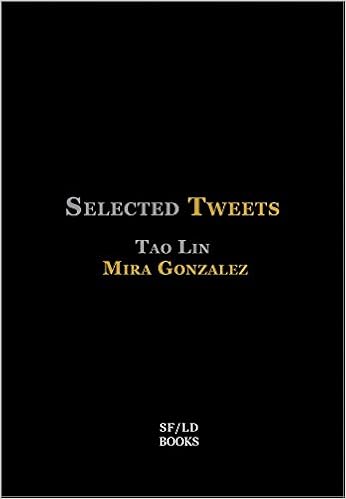
In writing the codes for my Twitter bot, I chose sentence structures that were common in Mira Gonzalez and Tao Lin’s Selected Tweets (which we have been studying). For example, “[pronoun] [did something], and [that’s why something else].” seemed to be a frequent structure. As well as “[doing something] in [a place] [was/is] [adjective].” So, my two origins were based on these structures.
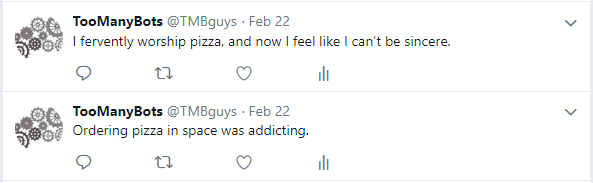
I also used words and phrases to fill my word banks that were frequent in Gonzalez and Lin’s tweets. I chose to do this because the nature of the two poets tweets are very random, and have ridiculous premises. Obviously, people tweet things like that though, so a bot that spouts out similar tweets wouldn’t be absolutely ridiculous (well, I suppose that’s debatable).
In doing this project, I wasn’t necessarily trying to create a bot that would create literary valuable tweets, but I was trying to create one that was more relatable than your average bot. Also, I aimed to create tweets that played off of the random nature of a twitter bot. I think I succeeded in this goal, most of the tweets made sense, and could have been posted by a real person. Also, I think they were some pretty entertaining tweets!

Comparing this form of literature with the previous twitter literature I created, I would definitely say that creating a “twitter story” is more literary valuable. Creating a Twitter story gives you so much more freedom and variables you can play with. Using a twitter bot, you would not really be able to create a coherent story across multiple tweets, because it is just so random. You could definitely use a Twitter bot to create multiple short stories in singular tweets. The more words you have in your word banks, the more stories it would create, but each story would be limited to a separate tweet. So, I believe that you can definitely create more valuable literature on Twitter without a bot.
That being said, I do not think that bots take away the humanity of writing tweets. You are still required to write all the code, phrases, word banks, and structures yourself. There is still quite a bit of creativeness and detail that has to go into creating the code for these bots. It is certainly a form of literature, although it has more limitations than “traditional” literature. I would also argue that this form of literature doesn’t “mass produce” content, At least, not any more than content is already mass produced on Twitter.

Creating a twitter bot was a very interesting experience, and I think it would be a lot of fun to keep expanding on my structures and word banks. Although, before I do that, I would really like to create some more twitter stories! I think there are so many fun options, using multiple accounts, and/or retweets, and/or other aspects that twitter can offer.
Thank you for reading! I hope you enjoyed!




 {Micah's (Digital)} Portfolio