Blog Post #2: Do Emojis Count as a Language? ~OR~ We, the 👮‍♀️👷‍♂️👨‍⚖️👩‍🏭👩‍🔬👨‍🌾 of the United States of America…

After reading Xu Bing’s Book from the Ground: From Point to Point, a novel composed entirely of emojis, a question must be raised: Do emojis communicate ideas well enough to be considered a language? In order to answer this question, we have to first examine what the purpose of language is.

A written language only exists so that ideas can be spread more effectively, and have a sense of permanence in the world. Anything written on paper has the same amount of permanence as English does written on paper, so emojis have that box ticked.

Now, do written down emojis spread ideas (and by ideas I mean stories, thoughts, emotions, knowledge, or anything else you might write down) effectively? I think that yes, emojis do convey ideas as well as any other language, emojis are just a language that is more new and less well known than most others. There are no rules of grammar or structure that this language has yet, and I would argue that it actually doesn’t even need those. Regardless emojis were made to be an optical form of communication (that is, read instead of heard), and they can express ideas effectively, so I think emojis are an effective form of language.

From very early in Bing’s Book from the Ground, there are passages that illustrate how well emojis can communicate ideas.

Excerpt from page 4 of Xu Bing’s Book from the Ground: From Point to Point.

The above passage, on page 4 of Bing’s book, tells us that the main character opened his door, and at his door was a delivery guy who brought him a package. The main character opens the package and finds it is a book that he, presumably, ordered. He begins to read it while drinking his coffee. He gets carried away with the book, loses track of time, and then smells his breakfast burning, so he has to throw it out, but he is still hungry.

These events are all portrayed pretty clearly, and they are all events that we, if we live in the middle class in a first world country, have all experienced. Now, the aspect that sets emojis apart from other languages, is that there is room for you to insert your own imagination into the story. Because there are no rules for the language of emojis, there are certain parts of the story that are left undefined that you, as a reader, are able to expand upon.

For example, you could choose what book he is reading, or you could forget about that detail, and just accept that he is reading a book. You can imagine the conversation and interaction the main character had with the delivery guy. Was the delivery guy polite? Simply neutral? It’s up to you, and you don’t even have to stop to fill in those gaps, you do it automatically while reading and creating the story in your own head.

At least, that’s my theory. That is definitely how it worked for me. One section in which I felt I was able to create some of the emotion and tone behind the narrative was the portion near the end of the above passage. It explained that he was reading and drinking his coffee, and everything was nice and relaxed… AND SUDDENLY HE HAD TO RUSH TO TAKE CARE OF HIS BURNING FOOD. I have been dragged into a story and lost track of time very frequently, so instead of reading an author’s description of how the main character felt, I was able to reimagine my emotions and the feeling of being in that moment. Because of sections throughout the book, I felt that the emojis made Book from the Ground a more immersive book than some others written in English.

There is, of course, an obvious argument to this theory. The argument that, if there are things in the writing left up to interpretation, won’t some of the meaning become lost? Or won’t it be hard to explain exactly what you mean? I definitely agree with this argument, in that the fluidity of meaning from emojis renders them almost useless in certain cases. Emojis would not be effective when, say, writing a constitution for a new country that all sense of justice will be based on in the future. You will need a language more adept at detail than emojis for that (besides, who’s going to take your country seriously if you write your constitution in emojis?).

Photo of George Washington after the Declaration of Independence was signed, 1776; Colorized.

However, when writing a story, whether fictional or real, emojis are able to immerse the reader and convey feelings in a way that many languages often can not. Also, when writing a story in emojis, if there is something that you want to make 100% sure come across the same to all your readers, you are able to specify your meaning with the large number of options available to you, or even by creating your own emoji! Bring out your inner artist.
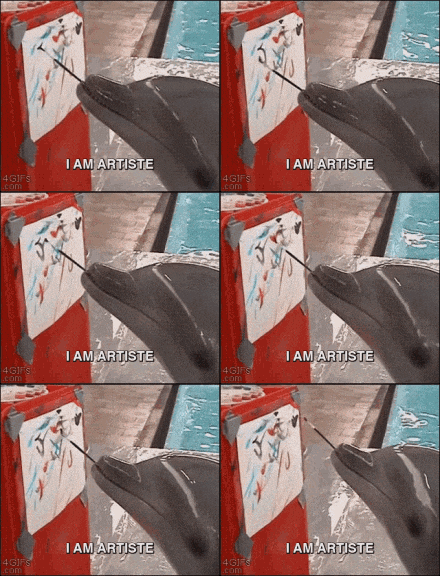
Actually better than I can paint.

So, in conclusion don’t write important historical documents in emojis. But definitely do take a risk, and experiment writing an immersive and relatable story in emojis! Thank you for reading, I hope you enjoyed my thoughts on emojis and language.

Digital Lab Assignment #4: Lost in Translation ~or~ 📖😀😊😶🤔&🚫🔠〰🎥🎬❓

👋❗ 🙏🔎💻❗

👁〰📖📅. 📖〰🌄➡📘. ✍〰😃😛😮🙁😬😉❗ 🚫🔠 ❗

😁👍✔. 👤😵❓ 👌.

Imagine reading a whole book that is only written like that! Some people shudder at the idea of struggling through a novel with only emojis, but others are intrigued at the idea. The book I am referring to is Xu Bing’s Book From the Ground: From Point to Point. Bing is a visual (and sometimes linguistic) artist that wrote about the life of an average office worker, using only emojis. Bing wanted to create a novel that anyone could read, regardless of what language they spoke. He created it partially as an antithesis to his work Book From the Sky, which is equally as fascinating, but nearly impossible for most people to read.

Picture of an installation of Xu Bing’s Book From the Sky at the Blanton Museum of Art

In our Literature by the Numbers class, we discussed the implications of using this as a language. Does it count as a language? Does it replace language? If so, is that a bad thing? Or a natural evolution of language? These are definitely interesting topics of discussion, but not what this post is about. In order to examine the relationship Book From the Ground has with language, each person in our class translated a chapter from the book into a form of their choosing. I was assigned to the first chapter, and I decided to turn it into a script for a screenplay.

Excerpt from the first chapter of Xu Bing’s Book From the Ground.

I’m sure that I made lot’s of technical errors in the actual forms and whatnot of screenplays, but it was definitely fun to try!

We also got paired up with a partner who translated the same chapter, but in a different way. This led to some interesting discoveries about the differences between interpretations of the same chapter, and the successes and shortcomings of emojis as a language.

As you can see, my translation is much different than my partners translation, but it got across the same story. While I was writing my translation, the ambiguous nature of the language actually helped me to write my screenplay. There was a lot of freedom about the specifics of the story, so I took some creative liberties while writing the screenplay. The way I translated was also more in depth than other options, and it took more time than I thought it would. In the end though, it made me appreciate the possibilities that the vagueness of the emoji medium offered.

Comparing my translation to my partners, I thought it was interesting that we interpreted certain details into our translation that were not included in the book. For example, we both said that the main character’s cat walked on his face to wake him up, but that was not specified in Xu Bing’s book.

(I know this cat isn’t on the person’s face, but it’s really cute)

My partner and I also both gave the main character and his cat specific characterizations. We gave them names, thoughts, and identities that were not included in the book. Similarly, we both were very in-depth with our translations. We had the option to just say “A bird was singing outside. A guy woke up and turned off his alarm clock. His cat came and woke him up…..”, but neither of us did. We were both compelled to tell a story, one that had intricacies and interesting details. I’m not sure if that says more about us, or more about the book we were translating, but it does show the need for humans to make explanations for what their brains are thinking.

Now, talking about these translations in the context of “literature by the numbers”… Although it is difficult to think of language in the term of numbers, emojis bring the relationship between language and numbers closer. Emojis are inherently digital, and although they are conveyed through an image, they are, at their core, a collection of ones and zeros. If we do accept emojis as a language, then they can be analyzed digitally more than most languages can. This shows that language itself can be quantified under the right circumstances.

This brings up the question; “So what?” Why would you want to quantify language? Well, my answer is that I, personally, don’t. Not right now. But later I might want to quantify a certain aspect of people’s communications with one another for an experiment, for example. For that reason, maybe I will try to use a language that has a closer relationship with numbers than English does. Like emojis, or some other form of language that happens to pop up. The possibilities, really, are endless.

If you are interested in the possibility of emojis being a language, or just intrigued about reading a book written entirely from emojis, check out Book From the Ground! It is a very entertaining read!

I hope you enjoyed this post! 🙏 👁〰💻❗