Blog Post #3: Authorship, Authorship, Who’s Got the Authorship?… ~OR~ Densha Otoko vs. The Netizens

It feels like it has been so long since I have written a post on this website! Alright, let’s do this.
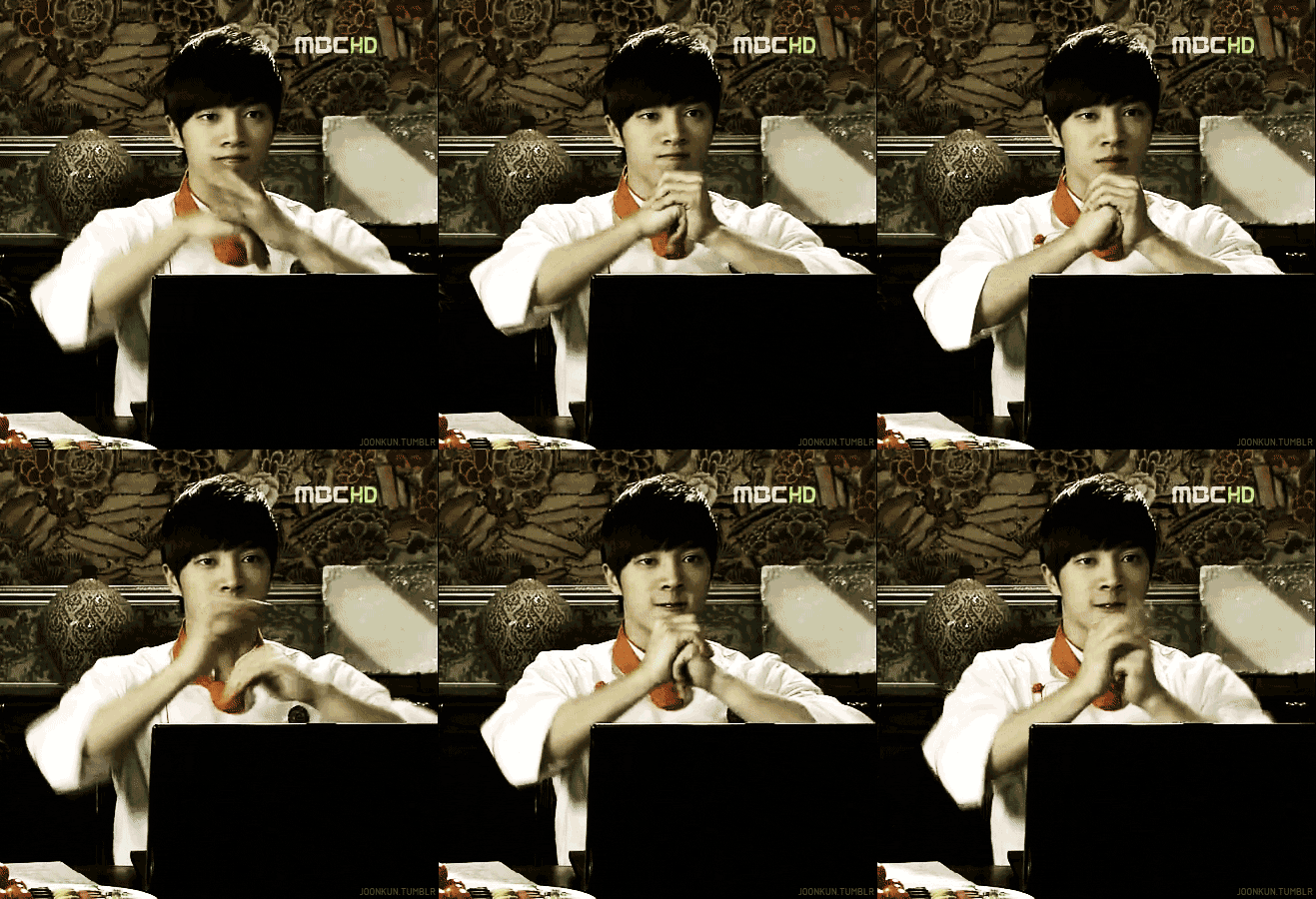
Actual Footage of Train Man before typing to the 2Chan chat (probably).

This week on Reading Books and Writing About Them: Train man. Novel. Internet/Romance/????. Author: everyone and no one all at once (officially, Hitori Nakano, which is a Japanese pun referring to all people part of message boards on the internet).
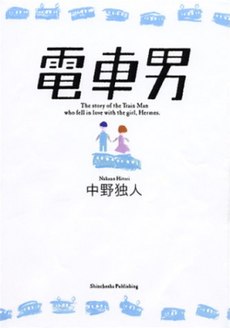
Cover of the novel version of Train Man (Densha Otoko in Japanese).

Train Man is an extremely unique novel, and it’s origin story is one of the reasons this story became so popular. The novel Train Man tells a story through a collection of chat posts from an online chat forum called 2 Channel. The story is that of your average Japanese geek (code name: Train Man) who meets a girl (code name: Lady Hermes) on the train and breaks out of his geekiness to try to win her over. Train Man turns to a chat forum he frequents to ask the people of the internet for help, since he doesn’t know how to act around girls.

Train Man and Hermes from the film adaptation.

Theoretically, this is a true story, and everything that was written down on this real internet chat room happened. According to legend, it became so popular that it spread from person to person, forum to forum, and Japanese people from all over fell in love with the story. Eventually, this novel (as well as a film, manga, and other media adaptations) was created as a byproduct. However, some people do not think that the story of Train Man is real. It seems to be a fact that the story did truly start online, but some people theorize that it didn’t actually transpire the way people want to believe it does (or at all). So, this raises the question; who wrote Train Man?

I think it was a combination of these guys (the internet as a whole):

The Netizens (citizens of the internet).

And this guy:

Train Man (Densha Otoko). Is it just me or does he lowkey look like John Lennon?

While it is a story about Train Man, and the novel revolves around his relationship adventures, the Netizens were imperative in writing the majority of the novel Train Man. In fact, they even wrote some of the “lines” that Train Man used (or took into account when speaking to Lady Hermes), which makes it clear that the Netizens did play a large role in this story. However, to say they have authorship over what Train did, or his relationship, is absolutely ridiculous. They didn’t do any of the actual work, so Train Man is still the hero in my book.

Train Man might not be the hero we deserve, but the one we need (much like this cat).

The reason I see Train as the author of Train Man, is that his actions extend beyond the screen, or just the physicality of typing. While the physical book consists mostly of comments from the Netizens, the story is carried solely by Train Man. Train is able to actually break out of his shell, and he is the reason we have the story of Train Man today. Of course, the Netizens helped him break out of his shell, but they are more like the wise old man that gives the main adventurer a bit of aid at the beginning of his story.

The world is not in your computer and chat forums…

Train Man was an amazing novel! I would recommend it if you are interested, here is some more information about it. The story was one of modern love, and how you should always pay attention when you are riding on trains in Japan, because you never know what might happen.

I hope you enjoyed the post! Thanks for reading.

Blog Post #2: Do Emojis Count as a Language? ~OR~ We, the 👮‍♀️👷‍♂️👨‍⚖️👩‍🏭👩‍🔬👨‍🌾 of the United States of America…

After reading Xu Bing’s Book from the Ground: From Point to Point, a novel composed entirely of emojis, a question must be raised: Do emojis communicate ideas well enough to be considered a language? In order to answer this question, we have to first examine what the purpose of language is.

A written language only exists so that ideas can be spread more effectively, and have a sense of permanence in the world. Anything written on paper has the same amount of permanence as English does written on paper, so emojis have that box ticked.

Now, do written down emojis spread ideas (and by ideas I mean stories, thoughts, emotions, knowledge, or anything else you might write down) effectively? I think that yes, emojis do convey ideas as well as any other language, emojis are just a language that is more new and less well known than most others. There are no rules of grammar or structure that this language has yet, and I would argue that it actually doesn’t even need those. Regardless emojis were made to be an optical form of communication (that is, read instead of heard), and they can express ideas effectively, so I think emojis are an effective form of language.

From very early in Bing’s Book from the Ground, there are passages that illustrate how well emojis can communicate ideas.

Excerpt from page 4 of Xu Bing’s Book from the Ground: From Point to Point.

The above passage, on page 4 of Bing’s book, tells us that the main character opened his door, and at his door was a delivery guy who brought him a package. The main character opens the package and finds it is a book that he, presumably, ordered. He begins to read it while drinking his coffee. He gets carried away with the book, loses track of time, and then smells his breakfast burning, so he has to throw it out, but he is still hungry.

These events are all portrayed pretty clearly, and they are all events that we, if we live in the middle class in a first world country, have all experienced. Now, the aspect that sets emojis apart from other languages, is that there is room for you to insert your own imagination into the story. Because there are no rules for the language of emojis, there are certain parts of the story that are left undefined that you, as a reader, are able to expand upon.

For example, you could choose what book he is reading, or you could forget about that detail, and just accept that he is reading a book. You can imagine the conversation and interaction the main character had with the delivery guy. Was the delivery guy polite? Simply neutral? It’s up to you, and you don’t even have to stop to fill in those gaps, you do it automatically while reading and creating the story in your own head.

At least, that’s my theory. That is definitely how it worked for me. One section in which I felt I was able to create some of the emotion and tone behind the narrative was the portion near the end of the above passage. It explained that he was reading and drinking his coffee, and everything was nice and relaxed… AND SUDDENLY HE HAD TO RUSH TO TAKE CARE OF HIS BURNING FOOD. I have been dragged into a story and lost track of time very frequently, so instead of reading an author’s description of how the main character felt, I was able to reimagine my emotions and the feeling of being in that moment. Because of sections throughout the book, I felt that the emojis made Book from the Ground a more immersive book than some others written in English.

There is, of course, an obvious argument to this theory. The argument that, if there are things in the writing left up to interpretation, won’t some of the meaning become lost? Or won’t it be hard to explain exactly what you mean? I definitely agree with this argument, in that the fluidity of meaning from emojis renders them almost useless in certain cases. Emojis would not be effective when, say, writing a constitution for a new country that all sense of justice will be based on in the future. You will need a language more adept at detail than emojis for that (besides, who’s going to take your country seriously if you write your constitution in emojis?).

Photo of George Washington after the Declaration of Independence was signed, 1776; Colorized.

However, when writing a story, whether fictional or real, emojis are able to immerse the reader and convey feelings in a way that many languages often can not. Also, when writing a story in emojis, if there is something that you want to make 100% sure come across the same to all your readers, you are able to specify your meaning with the large number of options available to you, or even by creating your own emoji! Bring out your inner artist.

Actually better than I can paint.

So, in conclusion don’t write important historical documents in emojis. But definitely do take a risk, and experiment writing an immersive and relatable story in emojis! Thank you for reading, I hope you enjoyed my thoughts on emojis and language.

Blog Response #1: What is “Literature by the Numbers”? ~or~ Flipping the Bird, Socks, and Led Zeppelin

To me “Literature by the Numbers” immediately implies the measurement or quantification of forms of literature. There are many ways one could quantify literature, and there are many ways one could define the word “literature”; let’s start with the latter issue first.

“Literature” is a term that gets argued over more than one might think. From my perspective, the defining points of literature are that it (1) tells a story and/or (2) conveys or explains a person’s thoughts. I would argue that any entity that completes either (preferably both) of these two functions is a form of literature. This would include books, video games, songs, paintings, and artistic arrangement of plants. Even flipping someone off could be construed as a form of literature, if the purpose is to convey the thought that you are very mad at someone.

Image result for kid flipping off gif

Regardless of the form of literature, you can always quantify it in some way. But in which way to do it? This brings us back to the first issue, regarding the way in which to quantify literature. It is a bit more difficult for me to discern, so I asked myself another question: “Why? Why do my socks always disappear after putting them in the dryer?” Then I realized that that question is besides the point, we are talking about literature here. A more on topic question (although about equally as baffling) would be “Why would you want to quantify literature?”

Image result for socks lost in dryer

I, personally, have no inherent interest in quantifying literature, although someone apparently does *coughAislinncough*. But whatever your reason for doing it, that reason will tell you how to go about the quantification.

Let’s say, for example, that you want to know which song lyrics (from all the songs in the album How the West Was Won, by Led Zeppelin) are the most difficult to understand. You would be able to get numbers from Google about which song lyrics are most often searched (besides “Stairway to Heaven”, that song will have been searched thousands of more times by each of the new guitarists who are only learning to play so that they can get ladies). These numbers could lead you to start quantifying the syllable/time ratio of each verse, in order to discern which lyrics must be said fastest, and therefore would be hardest to catch. You could continue to do many kinds of measurements of each song until you were able to compile a compelling argument as to which song’s lyrics are truly the most difficult to understand. In this way, you have subjectively analyzed an objective art form, which could appeal to certain peoples’ need for solid facts. (By the way, my vote is for “Immigrant Song”, at least that recording of it. I frickin love the song, but it took my forever to figure out what he was saying.)

220px-led_zeppelin_-_immigrant_song

The point is; The end (the reason you want to measure literature) justifies the means (the way in which you quantify literature). I know that’s not how you’re suppose to use that saying, but it worked well, and I’m the one writing this blog, not you.

So. long story short (I know, too late for that), to me the important part of “Literature by the Numbers” is the quantification of literature. And the reason you are quantifying literature is as important as the way you are quantifying said literature.

Thanks for reading, I’d love to hear your thoughts on the matter; feel free to comment below. Now go out and do some quantifying!

About Me (for real) ~or~ Welcome to the Machine

My name is Micah Taylor, I am currently an undergrad student at the University of Utah. I have created this blog space/website primarily for the class “Literature by the Numbers” taught by Dr. Aislinn McDougall. So most of my posts will probably be about literature. Or numbers. Or both. Maybe neither, who knows? Definitely not me. Anyway, I was born in Utah, moved away for a bit to live in Washington, and now I’m back and was raised (mostly) in Utah. I love Utah because of all the amazing outdoor activities/opportunities. I also love to read, play games of any type, and act. Music is another passion of mine, whether I am playing it or listening to it. I am always interested in learning new things, about anything and everything. I like to have intellectual conversations, but I also like to be funny, so hopefully this website will reflect both of those aspects. Thanks for visiting, I hope you enjoy!