
Inspired by the project Between Page and Screen, by Amaranth Borsuk and Brad Bouse, a partner and I created a conversation between alternate versions of page and screen. Here is the epistle that I created (this should be read first):
Screen: http://www.betweenpageandscreen.com/epistles/1uvIv5zL
And here is my partner’s response:
Page: https://www.betweenpageandscreen.com/epistles/LcdASYPg
In order to read these pieces of literature, you will need to use this QR code and your computer’s camera. You can either take a picture of it and hold your phone up to your camera, or you can print the QR code out.
Now that you have read those (or not. I guess you don’t have to read them. But it may help you to understand what I am talking about if you do.), let’s discuss this form of literature.

Firstly, there is the matter of the QR code as the medium to epitomize the relationship between page and screen. The QR code is just one of many ways something not digital can communicate with something that is digital, so I feel it was an effective way to illustrate the relationship between page and screen. You are required to use both paper (if you actually buy/print out the book) and screen to read about these two mediums. Additionally, I would say that this is a form of ergodic (meaning difficult to traverse or read) literature, which I feel is a fantastic elaboration on the complicated and tenuous relationship between the two parties in question. However, I do feel that there is much more to be said about the relationship between page and screen than the QR code can convey. That being said, I would be hard pressed to come up with another code to use to illustrate the relationship between page and screen. The QR code is definitely an effective way to communicate the interaction, but it is not the epitome of their relationship.
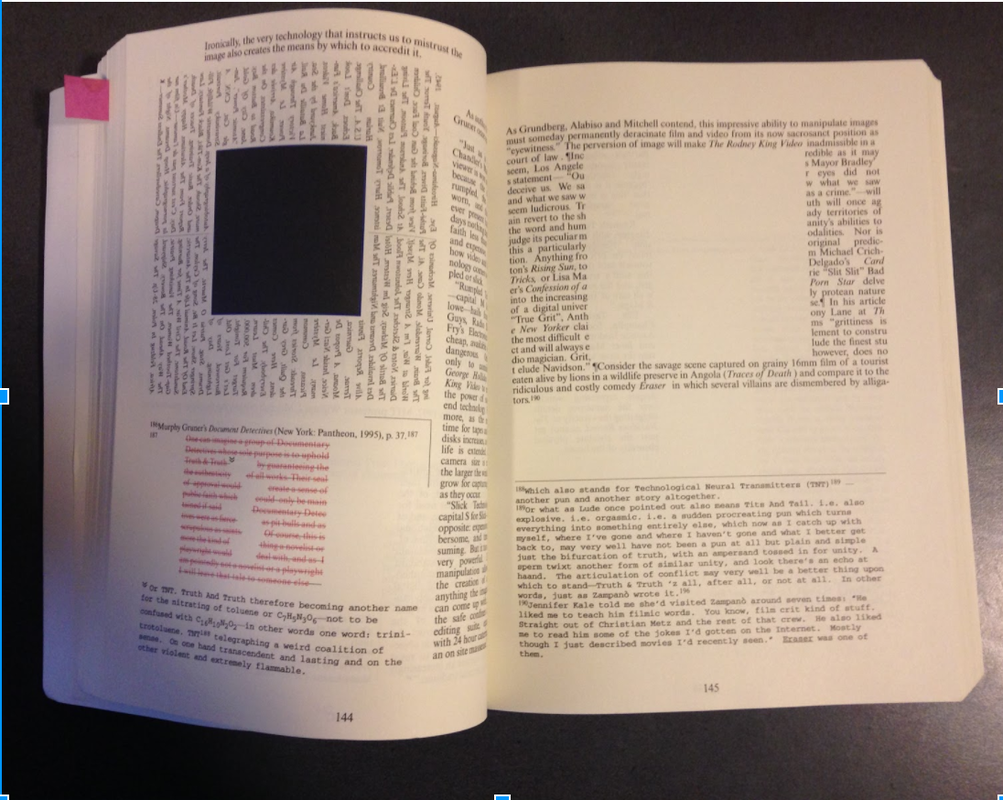
From House of Leaves, by Mark Z. Danielewski
One large theme of the relationship between page and screen is whether or not one is more prevalent than the other. I do think that screen is becoming more prevalent than page, but not through any fault of his own, he is simply the medium in the literary machine of cybertext. In my opinion, both mediums and forms of literature are equally as valuable and important, but I see Page as being more at risk. The screen as a medium is becoming more and more prevalent, and definitely seems to be overtaking the medium of page. However, if I were to anthropomorphize these mediums, I do not think that it is screen’s fault that he is taking over page. He is at the mercy of humans; they will use him as they see fit and there isn’t much he can do about it. Thus, we can see the screen as being a part of the machine of cybertext, because users are an integral part of it’s literature, even more important than the screen itself.

Alright….went off the handle a bit there. Regardless, it would be interesting to examine the relationship between page and screen through a format that conveyed screen’s interactivity with cybertext. But, again, I am hard pressed to say what that would be. Let me know if you think of a way that could work! For now, Between Page and Screen is a fantastic illustration of the tension and relationship of these two prominent mediums in the literary world. If this post intrigued you, definitely check out Borsuk and Bouse’s work!
Thanks for reading!
 {Micah's (Digital)} Portfolio