Digital Lab Assignment #3: Dismantling Frustrating Texts ~OR~ Mary Do You Wanna…

The inspiration for this week’s assignment came from Jordan Abel’s long poem Injun. I would definitely recommend at least listening to the reading that is in the link I provided. It is an amazing project. Abel created his poem by cutting up words from a source text of pieces of text that offended him (by using the derogatory word Injun). He arranged and rearranged the cut out words and ended up with this as one of his segments:

Excerpt from Injun by Jordan Abel.

We were asked to bring a piece of text that offended us, or at least one you wanted to deconstruct. I do not get offended easily, even for a straight white male, so I settled on something that I wanted to shred apart. During the whole fight around Proposition 2 (referred to the church by “the Marijuana Initiative”, this was the proposition that wanted to legalize medical cannabis use in Utah), the LDS Church sent out a statement of why they opposed Proposition 2. During their whole crusade, most of their information was either misleading, or not based on any real facts. The excerpt I dismantled was no exception.

I began dismantling my piece using an online tool called Voyant. I copy/pasted about a page from the LDS Church’s list, and Voyant gave me data on each word and its structure in each sentence.

Screenshot of the data analysis that Voyant gave me.

Immediately noticeable is the fact that ‘cannabis’, ‘marijuana’, and ‘medical’ are the three most used words in my piece of text. Obviously, the text is about medical cannabis, so it’s not surprising that those are the top three hits. However, upon closer inspection, I realized that the word ‘medical’ only appeared before the word ‘marijuana’ or ‘cannabis’. This use of ‘medical’ is only a pre-implemented explanation of the word ‘cannabis’ or ‘marijuana’. This makes it seem like the LDS Church isn’t concerned with any of the medical issues that are the reasons medical marijuana is needed in the first place. Additionally, they claim that their interest is in keeping people safe, but the words ‘person’, ‘people’, or any other compassionate term, do not show up even in the Top 10 most frequent words. The word ‘Utahan’ only appears once, and ‘safe’ or ‘safety’ or any other term with that meaning? Not at all.

Lawn signs in support of Proposition 2.

So if they aren’t concerned with that, what is their issue with Proposition 2? One recurring theme that seems to be an issue is the medical cannabis dispensaries. The LDS Church finds multiple reasons why the medical marijuana dispensaries, and the regulations surrounding them, will be inefficient or will “hamper the law” (again, their claim for this point is based on no factual evidence).

Now, add in to the mix the fact that the LDS Church has purchased major stock in pharmaceutical companies. I could go on a whole tirade about this, and the abuse-of-prescription-drugs-epidemic in Utah, but basically a very major source of the church’s (unethically sourced) funding comes from pharmacies. The medical marijuana dispensaries, however, would be independent from any pharmacies or corporate drug producers. If medical marijuana were to be dispensed as proposed, it would immediately alleviate anybody’s need for many prescriptions drugs and their terrible side effects (not to mention their lack of effectiveness). This would cause a large drain on the income for pharmacies, and thus would be a huge cut in the church’s paycheck. It seems like the LDS Church is against the dispensing of medical cannabis for the simple reason that pharmacies (or themselves) are not involved in it, and therefore will not get any cut of the benefits.

A comic that I think perfectly represents the need for medical cannabis, and why the LDS Church has been fighting so hard against it.

Keeping all this in mind, I ended up creating this project out of the text I chose:

Picture of my finished project.

I began by cutting out key words I believed were important to the issue and laying them on the ground. I actually originally arranged them in sentences, which helped me express my thoughts. However, after some experimentation (and frustration after my cat walked over the pieces and scattered everything about), I came upon the above format, which I must say I am very proud of.

I hesitate to explain everything in my piece of work above, because I feel that it takes the fun out of everything. However, after explaining my interpretation of the data given to me by Voyant, and given my cynical view of the LDS Church’s motives, I’m sure this piece can be entertaining to you as well.

Thanks for reading!

Digital Lab Assignment #2: (QR) Code in Literature ~or~ Anthropomorphism is Fun (to Write)

Inspired by the project Between Page and Screen, by Amaranth Borsuk and Brad Bouse, a partner and I created a conversation between alternate versions of page and screen. Here is the epistle that I created (this should be read first):

Screen: http://www.betweenpageandscreen.com/epistles/1uvIv5zL

And here is my partner’s response:

Page: https://www.betweenpageandscreen.com/epistles/LcdASYPg

In order to read these pieces of literature, you will need to use this QR code and your computer’s camera. You can either take a picture of it and hold your phone up to your camera, or you can print the QR code out.

Now that you have read those (or not. I guess you don’t have to read them. But it may help you to understand what I am talking about if you do.), let’s discuss this form of literature.

From Between Page and Screen

Firstly, there is the matter of the QR code as the medium to epitomize the relationship between page and screen. The QR code is just one of many ways something not digital can communicate with something that is digital, so I feel it was an effective way to illustrate the relationship between page and screen. You are required to use both paper (if you actually buy/print out the book) and screen to read about these two mediums. Additionally, I would say that this is a form of ergodic (meaning difficult to traverse or read) literature, which I feel is a fantastic elaboration on the complicated and tenuous relationship between the two parties in question. However, I do feel that there is much more to be said about the relationship between page and screen than the QR code can convey. That being said, I would be hard pressed to come up with another code to use to illustrate the relationship between page and screen. The QR code is definitely an effective way to communicate the interaction, but it is not the epitome of their relationship.

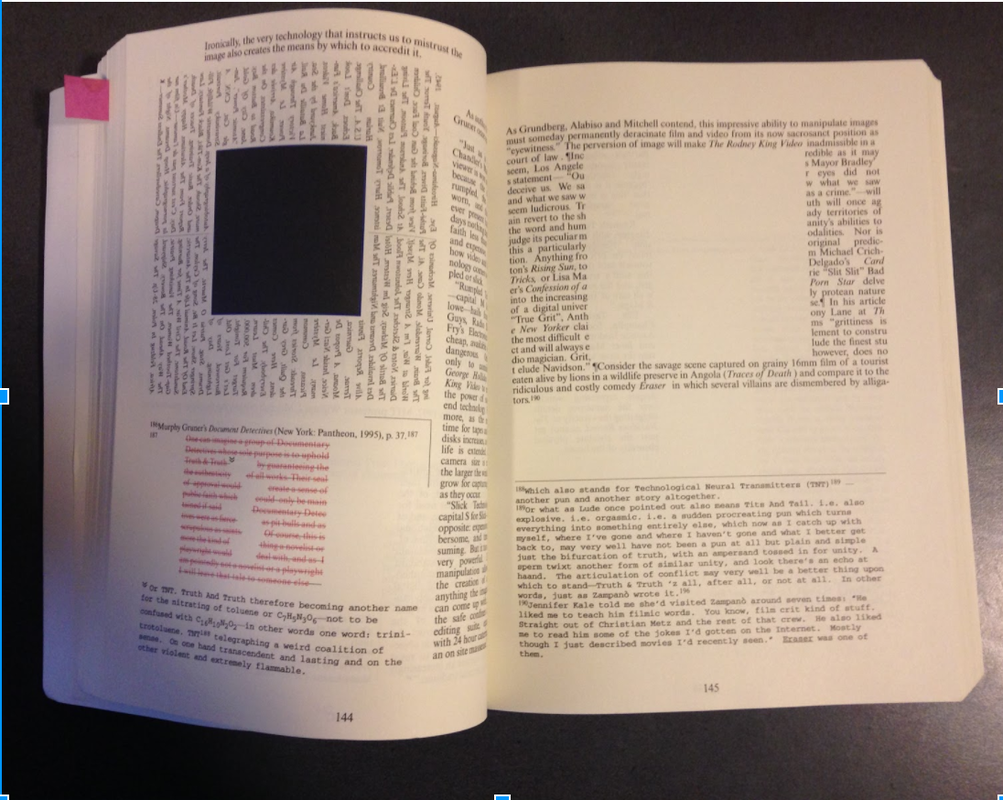
Another example of ergodic literature.
From House of Leaves, by Mark Z. Danielewski

One large theme of the relationship between page and screen is whether or not one is more prevalent than the other. I do think that screen is becoming more prevalent than page, but not through any fault of his own, he is simply the medium in the literary machine of cybertext. In my opinion, both mediums and forms of literature are equally as valuable and important, but I see Page as being more at risk. The screen as a medium is becoming more and more prevalent, and definitely seems to be overtaking the medium of page. However, if I were to anthropomorphize these mediums, I do not think that it is screen’s fault that he is taking over page. He is at the mercy of humans; they will use him as they see fit and there isn’t much he can do about it. Thus, we can see the screen as being a part of the machine of cybertext, because users are an integral part of it’s literature, even more important than the screen itself.

Image result for anyway gif

Alright….went off the handle a bit there. Regardless, it would be interesting to examine the relationship between page and screen through a format that conveyed screen’s interactivity with cybertext. But, again, I am hard pressed to say what that would be. Let me know if you think of a way that could work! For now, Between Page and Screen is a fantastic illustration of the tension and relationship of these two prominent mediums in the literary world. If this post intrigued you, definitely check out Borsuk and Bouse’s work!

Thanks for reading!

Blog Response #1: What is “Literature by the Numbers”? ~or~ Flipping the Bird, Socks, and Led Zeppelin

To me “Literature by the Numbers” immediately implies the measurement or quantification of forms of literature. There are many ways one could quantify literature, and there are many ways one could define the word “literature”; let’s start with the latter issue first.

“Literature” is a term that gets argued over more than one might think. From my perspective, the defining points of literature are that it (1) tells a story and/or (2) conveys or explains a person’s thoughts. I would argue that any entity that completes either (preferably both) of these two functions is a form of literature. This would include books, video games, songs, paintings, and artistic arrangement of plants. Even flipping someone off could be construed as a form of literature, if the purpose is to convey the thought that you are very mad at someone.

Image result for kid flipping off gif

Regardless of the form of literature, you can always quantify it in some way. But in which way to do it? This brings us back to the first issue, regarding the way in which to quantify literature. It is a bit more difficult for me to discern, so I asked myself another question: “Why? Why do my socks always disappear after putting them in the dryer?” Then I realized that that question is besides the point, we are talking about literature here. A more on topic question (although about equally as baffling) would be “Why would you want to quantify literature?”

Image result for socks lost in dryer

I, personally, have no inherent interest in quantifying literature, although someone apparently does *coughAislinncough*. But whatever your reason for doing it, that reason will tell you how to go about the quantification.

Let’s say, for example, that you want to know which song lyrics (from all the songs in the album How the West Was Won, by Led Zeppelin) are the most difficult to understand. You would be able to get numbers from Google about which song lyrics are most often searched (besides “Stairway to Heaven”, that song will have been searched thousands of more times by each of the new guitarists who are only learning to play so that they can get ladies). These numbers could lead you to start quantifying the syllable/time ratio of each verse, in order to discern which lyrics must be said fastest, and therefore would be hardest to catch. You could continue to do many kinds of measurements of each song until you were able to compile a compelling argument as to which song’s lyrics are truly the most difficult to understand. In this way, you have subjectively analyzed an objective art form, which could appeal to certain peoples’ need for solid facts. (By the way, my vote is for “Immigrant Song”, at least that recording of it. I frickin love the song, but it took my forever to figure out what he was saying.)

220px-led_zeppelin_-_immigrant_song

The point is; The end (the reason you want to measure literature) justifies the means (the way in which you quantify literature). I know that’s not how you’re suppose to use that saying, but it worked well, and I’m the one writing this blog, not you.

So. long story short (I know, too late for that), to me the important part of “Literature by the Numbers” is the quantification of literature. And the reason you are quantifying literature is as important as the way you are quantifying said literature.

Thanks for reading, I’d love to hear your thoughts on the matter; feel free to comment below. Now go out and do some quantifying!

About Me (for real) ~or~ Welcome to the Machine

My name is Micah Taylor, I am currently an undergrad student at the University of Utah. I have created this blog space/website primarily for the class “Literature by the Numbers” taught by Dr. Aislinn McDougall. So most of my posts will probably be about literature. Or numbers. Or both. Maybe neither, who knows? Definitely not me. Anyway, I was born in Utah, moved away for a bit to live in Washington, and now I’m back and was raised (mostly) in Utah. I love Utah because of all the amazing outdoor activities/opportunities. I also love to read, play games of any type, and act. Music is another passion of mine, whether I am playing it or listening to it. I am always interested in learning new things, about anything and everything. I like to have intellectual conversations, but I also like to be funny, so hopefully this website will reflect both of those aspects. Thanks for visiting, I hope you enjoy!